
Education in Africa: A Misunderstood Concept Hampering Youth Empowerment
Education and the Future of Africa’s Youth
Education is commonly defined as the process of acquiring knowledge and skills. Across continents, countries, and communities, development and progress are largely determined by the quality of education provided to young people. This is particularly significant because youth constitute a substantial proportion of Africa’s population. The nature of the education they receive directly shapes how well they are empowered, how prepared they are for leadership, and how effectively they can contribute to social and economic development (UNESCO, 2023).
Revisiting the True Meaning of Education
However, education is often misunderstood as merely the transmission of information or preparation for academic examinations. The Latin root of the word education—educa, meaning to lead out, draw forth, or develop from within—offers a deeper and more accurate understanding of its true purpose. Education, in its original sense, is meant to identify, nurture, and develop the latent talents, abilities, and potential that already exist within children and young people, rather than simply filling them with theoretical knowledge.
When education is reduced to rote learning and certification, this foundational purpose is lost, leaving many young people educated in theory but disconnected from their natural abilities and strengths.
Formal, Non-Formal, and Informal Education in Youth Empowerment
As important as education is to national and continental development, its forms and delivery methods must be critically examined in relation to youth empowerment. Education is commonly categorized into three interrelated forms: formal, non-formal, and informal education (UNESCO Institute for Lifelong Learning, 2022).
Formal education takes place within structured institutions such as schools and universities, guided by standardized curricula, timetables, and assessment systems. It emphasizes academic progression and certification, often with limited opportunities for practical application.
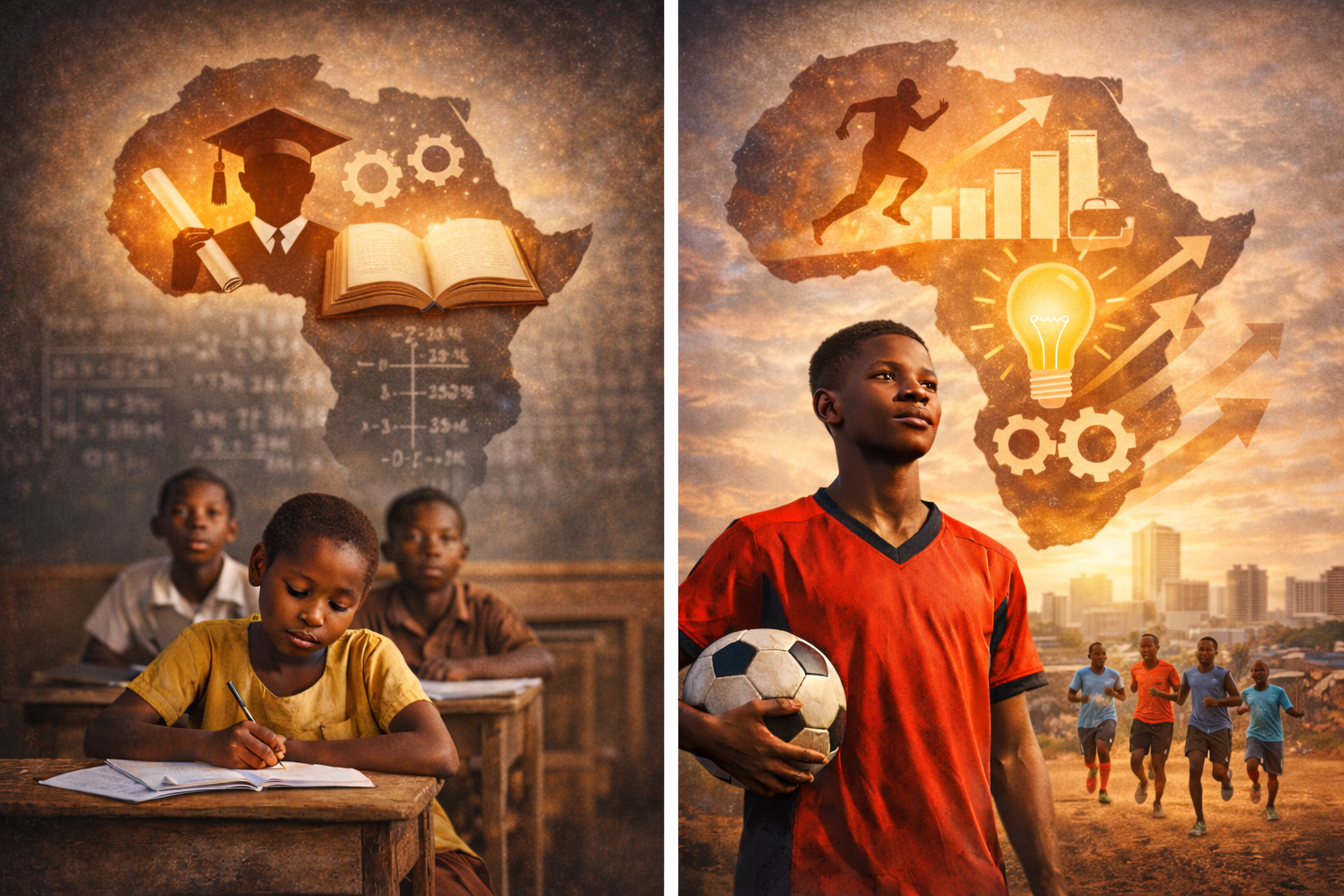
Non-formal education refers to organized, intentional learning that occurs outside the formal school system. This includes sports academies, youth leadership programmes, vocational training centres, community education initiatives, mentoring schemes, and skills-based workshops. Non-formal education is particularly effective in developing life skills, leadership, teamwork, discipline, and employability competencies (UNESCO, 2019).
Informal education, on the other hand, is unstructured and experiential. It occurs through everyday activities, family life, peer interactions, community engagement, volunteering, and cultural practices, where learning happens naturally without predefined curricula.
Together, these three forms of education are complementary and essential for holistic youth empowerment.
The Skills Mismatch and Youth Unemployment Challenge
Despite the value of all three approaches, many education systems in Africa—particularly in West Africa—remain heavily skewed toward theoretical formal education. Learning outcomes are frequently measured by examinations and certificates rather than by competence, creativity, adaptability, or problem-solving ability (African Development Bank, 2021).
As a result, many graduates leave school academically qualified yet insufficiently prepared for employment, entrepreneurship, or community leadership. This imbalance has contributed to the widely acknowledged skills mismatch between education systems and labour market demands, worsening youth unemployment across the continent (ILO, 2022; UNESCO, 2023).
A common example is the university graduate who holds multiple academic qualifications but remains unemployed or underemployed because their education did not sufficiently equip them with practical, transferable, or entrepreneurial skills.
Beyond Examinations: The Missing Elements of Empowerment
The overemphasis on examinations has also caused many educational institutions to place limited value on other critical components of youth empowerment. These include:
-
Talent identification and development
-
Leadership and character formation
-
Volunteering and civic engagement
-
Community development and social responsibility
Yet these elements are not optional. They are central to an education system that truly reflects the principle of educa—drawing out the full potential of the learner.
Evidence shows that young people who engage in non-formal education settings such as sports, leadership clubs, or community service often develop stronger life skills, confidence, and resilience than those exposed only to classroom-based instruction (UNESCO, 2019).
Redesigning Education for Holistic Youth Development
To address this misconception of education in Africa, educational systems must be reimagined and redesigned from the foundational level. Curricula and delivery methods should intentionally integrate formal academic learning with non-formal and informal opportunities for skill development, critical thinking, leadership training, and talent discovery.
Educational institutions and learning delivery organizations must be reoriented to place equal importance on academic achievement and holistic development, thereby producing well-rounded young people who are not only knowledgeable but also capable, ethical, and socially responsible contributors to national and continental development.
Cratos Academy’s Holistic Education Philosophy
This philosophy underpins the work of Cratos Academy, a football development organization committed to holistic youth empowerment. Cratos Academy recognizes football as a powerful non-formal education platform that complements formal schooling and informal learning experiences.
Through the integration of academic education, structured football coaching, character development, and structured leadership and mentoring programmes, the Academy nurtures well-rounded student-athletes. These young people are prepared not only to pursue excellence in sport but also to become purpose-driven individuals and ethical leaders who uplift their communities.
A Call to Rethink Education in Africa
Cratos Academy therefore invites volunteers, coaches, educators, and social investors who share this philosophy of education and youth development to partner in making this vision a reality. By redefining education as a process of eduction—developing what lies within—Africa can unlock the full potential of its youth and empower a generation capable of driving sustainable development across the continent.
References
-
African Development Bank (2021). Youth, Jobs, Skills and Educational Mismatch in Africa.
-
International Labour Organization (2022). Global Employment Trends for Youth.
-
UNESCO (2019). Education and Learning Pathways.
-
UNESCO (2023). The State of Education in Africa.
-
UNESCO Institute for Lifelong Learning (2022). Formal, Non-Formal and Informal Learning Frameworks.


This is what our generation want
Thank you coach
Great piece, thank you for the enlightenment and I know this will go a long way to make an impact in our generation and generation to come.
I believe this will have a lasting impact,benefiting not just our generation but those to come…keep up the good works..
Isaac Eshun Lamptey, isaaceshun1984@gmail.com
Well done Team! Keep up the inspirational and transformative work.
Wow. Nice piece. Very insightful and a must read. Thank you for sharing
Very insightful and educative post